


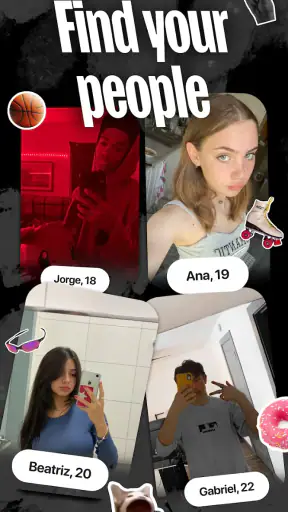
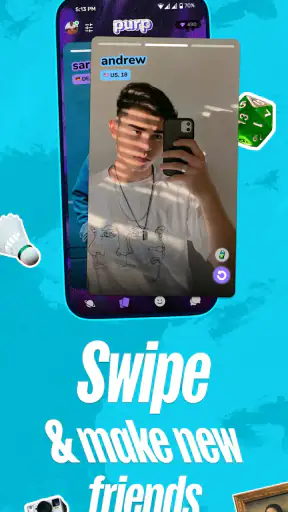
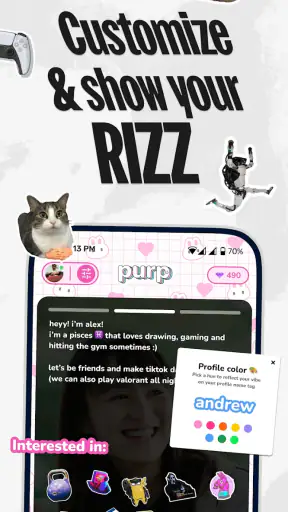
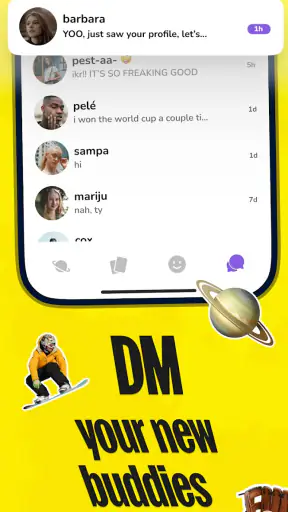

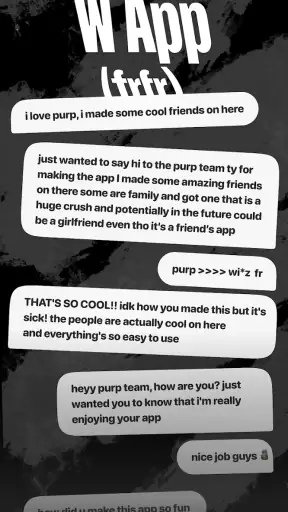
When I first opened purp, I understood its appeal immediately: it removes much of the awkwardness from meeting someone new. Instead of waiting for a conversation to happen in a crowded social feed, I could browse people, make a quick decision, and move on without turning every interaction into a public performance. That simple swipe-based approach is the app’s defining capability, and it works best when I treat it as a doorway to conversation rather than as a complete social life.
This is a free social app from hubo Labs, aimed at teenagers and older users. It is available for devices running Android 8.0 or later, and the current version is 6.5.0. The app has reached over five million installs, with an average score of 4.2 from roughly one hundred twenty-nine thousand ratings. Those figures suggest that the concept has found a substantial audience, but popularity alone does not make every match worthwhile. My experience was more positive when I used it with a clear idea of what I wanted from a new connection.
Why the swipe is more useful than it looks
A faster way to decide whether to start talking
The central feature is the ability to swipe through potential new friends. That sounds familiar because the gesture is now common across social and dating services, but the effect feels different when the goal is friendship. I was not trying to build a polished profile for romantic attention or compete for likes in a public timeline. I was simply deciding whether a person seemed interesting enough to meet through conversation.
That small change in purpose matters. A traditional social network usually begins with people I already know, while a chat platform often depends on finding the right group first. purp reverses that order. It puts discovery before community, which makes it easier to encounter people from different places and backgrounds. The store’s focus on new cultures and new people is therefore more than a slogan in practical terms: the swipe mechanic creates a steady stream of unfamiliar possibilities.
I found the format especially useful when I wanted low-pressure social contact. There is no need to write a long introduction to everyone I see. A short decision is enough to keep exploring. That makes the app approachable for someone who feels uncomfortable entering a large public group, where speaking for the first time can feel like interrupting an established conversation.
At the same time, the swipe is not a magic filter for personality. A profile can give me a reason to begin, but it cannot tell me whether a conversation will be respectful, lively, or sustainable. The best way to use the feature is to see it as a first screening step. I look for a genuine point of connection, then allow the chat itself to provide the evidence.
What this changes for international friendships
Meeting people from other cultures can easily become superficial. It is tempting to collect contacts, exchange a few greetings, and then disappear. purp’s discovery-first design can help with the first step, but the user still has to turn curiosity into a real exchange. I had better results when I asked specific, ordinary questions instead of treating someone as a representative of an entire country.
For example, asking about a person’s favorite local snack, a normal weekend, or the kind of music they play while studying gives the conversation somewhere to go. These questions are more useful than immediately asking for a complete cultural explanation. They also make the interaction feel mutual rather than like an interview.
The app is particularly appealing to people who want casual language practice. It does not replace a structured learning service, and I would not use it as a substitute for lessons or correction tools. However, chatting with someone who naturally uses another language can add context that exercises often miss: informal expressions, humor, hesitation, and the way people actually describe daily life.
There is also a trade-off here. Cross-cultural discovery is rewarding when both people are curious, but misunderstandings can happen more easily. Short messages may sound colder than intended, jokes may not travel well, and different expectations about reply speed can create unnecessary confusion. I learned to avoid judging a connection too quickly based on one brief message.
The practical rhythm of browsing and chatting
In everyday use, I would not open purp expecting every session to produce a close friend. The more realistic rhythm is to browse for a few minutes, notice one or two promising people, and start a conversation when I have enough time to reply properly. That approach prevents the app from becoming another feed that I scroll through without purpose.
A useful habit is to begin with a message that refers to something specific rather than sending a generic greeting. If a profile suggests an interest, I can ask a simple follow-up question. If there is no obvious topic, I can introduce myself with a detail that gives the other person an easy answer. This is a small workflow improvement, but it makes the swipe feature much more effective because it connects discovery with a practical opening line.
I also recommend setting a personal stopping point. Swiping can feel effortless, which makes it easy to continue long after the useful part of a session has ended. A short, intentional visit is better than repeatedly checking profiles while distracted. The app works as a social tool when I make decisions; it becomes less valuable when I use it only for endless browsing.
Where purp fits into real life
A realistic use case for a quiet afternoon
Imagine a student who has recently moved to a new city and has not yet built a local circle. Their classmates may be friendly, but conversations remain limited to schoolwork. Opening purp in the evening gives them a way to meet people outside that immediate routine. They can look for someone with a shared interest, begin with a low-pressure message, and gradually discover whether the connection deserves more time.
That scenario shows the app’s strongest quality: it creates an intentional first move. The student does not have to wait for a club, event, or friend-of-a-friend introduction. They can explore beyond their existing environment from a phone. The result will depend on the people they encounter and the effort they put into replying, but the barrier to trying is low.
I can see the same value for someone preparing to travel. A conversation with a person who lives in a destination may offer a more personal perspective than a standard guide. The important word is “conversation,” though. I would use the app to exchange general impressions and social context, not to rely on a stranger for safety-critical travel advice or private arrangements.
Another good scenario is a person who enjoys meeting people but dislikes crowded online communities. Large group chats can be noisy, fast, and difficult to enter. The one-to-one discovery implied by the swipe format feels more manageable. It gives the user a chance to focus on one exchange at a time instead of trying to understand an entire community’s rules and history.
How it compares with familiar alternatives
Compared with a general social network, purp feels more focused on meeting unfamiliar people. A conventional network is usually strongest for maintaining existing relationships, following known creators, and sharing updates with a broad audience. I would choose that kind of service when I want continuity with people already in my life. I would choose purp when discovery is the main purpose.
Compared with large messaging communities, the app has a simpler starting point. Group-based services are better when I already know the topic I want to discuss, such as a game, hobby, or local activity. They can lead to deeper communities, but finding the right group and becoming comfortable inside it takes time. purp is more direct for the initial act of meeting someone, although it may not provide the same shared structure that keeps a group conversation active.
Compared with dating-oriented swipe apps, the friendship framing is an important distinction. I would not approach every interaction with the same expectations or pressure. That makes purp a better fit for someone who wants social discovery without making romance the default interpretation. Even so, users should still communicate clearly and respect boundaries, because a swipe cannot guarantee that two people want exactly the same kind of connection.
Language-learning platforms remain the better option for formal progress. They normally organize practice around lessons, exercises, or corrections, while purp is built around meeting people. The advantage here is natural conversation; the disadvantage is that the quality and consistency of that practice can vary widely from one person to another.
Small habits that improve the experience
My first practical tip is to use the swipe as a selection tool, not as a scorecard. Choosing someone because their profile gives me a genuine conversation topic is more productive than trying to judge whether they look universally interesting. The goal is not to approve or reject a person’s worth. It is to identify a possible reason to say hello.
Second, I would avoid revealing personal details too early. A new international connection can feel exciting, but a first conversation does not require a real-time location, school information, private contact details, or anything that could identify a user offline. Keeping the opening exchange general gives both people room to decide whether trust is developing naturally.
Third, I would treat silence as normal rather than as a personal insult. A match or promising profile does not create an obligation to maintain a conversation. People may be busy, uncertain about what to write, or simply not interested after the first exchange. Moving on politely is healthier than trying to force a response.
Finally, I would use the app when I can give conversations a little attention. The discovery stage is quick, but friendship is not. If I open it while rushing between tasks, I may collect possibilities without giving any of them a fair chance. A few thoughtful messages are more valuable than a large number of shallow interactions.
The limitations behind the friendly concept
Discovery is easier than consistency
The swipe system solves the problem of finding someone new, but it does not solve the problem of keeping a friendship alive. That distinction is important before downloading. If I want a service that organizes recurring activities, shared projects, or long-running discussions, a community platform may suit me better. purp is strongest at the beginning of the relationship.
There can also be a quality gap between profiles. Some people make it easy to understand their interests, while others provide little material for a meaningful opening. When that happens, the browsing experience can become repetitive. I found that patience helps, but users who dislike uncertainty may prefer a service with more structured matching or topic-based rooms.
The app’s social nature also means that the experience depends heavily on who is active at the moment. A good concept cannot guarantee that every conversation will be available, balanced, or equally engaging. I would keep expectations flexible and avoid interpreting a quiet session as proof that the app has nothing to offer.
Safety and boundaries still belong to the user
Because the app encourages contact with strangers, I would be especially careful with personal boundaries. The Teen content rating makes it suitable for a younger audience category, but that does not remove the need for judgment. A user should stop replying when a conversation becomes pressuring, invasive, or uncomfortable. No new friendship is worth ignoring that instinct.
I would also keep early interactions inside the app’s normal social context rather than rushing to another service. Moving to a private channel can make it harder to step back if the relationship changes direction. A gradual pace is not unfriendly; it is a sensible way to test whether someone respects a simple boundary.
Parents and guardians considering the app for a teenager should discuss practical rules before use. The most useful conversation is not a blanket warning against meeting anyone. It is a clear agreement about what information stays private, how to respond to uncomfortable requests, and when to involve a trusted adult. That guidance matters more than the novelty of the swipe interface.
Free to start does not mean every option is cost-free
purp is free to download and use, which makes experimenting with its social format easy. It also includes optional in-app purchases ranging from forty-nine cents to twenty-nine dollars and ninety-nine cents per item. I would approach those purchases carefully. The free experience should be enough to decide whether the app’s basic discovery loop fits my habits before I spend anything.
The exact value of an optional purchase depends on how it affects the user’s own experience, but I would not buy impulsively simply because browsing feels slow or a connection seems important. A paid option cannot create mutual interest. If the underlying conversations are not enjoyable, spending more will not fix that central issue.
Another practical consideration is device compatibility. The app requires Android 8.0 or later, so anyone using an older phone should check the operating system before planning around it. On a supported device, the current 6.5.0 release provides the version context users will see when deciding whether to install or update.
Who gets the most from this app
The strongest audience
I think purp is a good choice for curious people who want to meet individuals beyond their existing circle. It suits users who enjoy short introductions, cultural exchange, and the possibility of finding a conversation partner without joining a large community first. It is also useful for someone who has recently moved, is preparing for travel, or wants informal language practice alongside everyday social contact.
The app rewards initiative. The person who gains the most is not necessarily the one who swipes the most, but the one who notices a real point of connection and follows it with a considerate message. A thoughtful user can turn a lightweight discovery tool into a meaningful routine by being selective, patient, and clear about boundaries.
I would be more cautious about recommending it to someone seeking guaranteed replies, carefully moderated professional networking, or a structured learning program. It is also not the right choice for a user who wants every interaction to happen inside an established interest group. In those cases, a specialized community or education service will probably provide more dependable structure.
My recommendation after using it
The real strength of purp is not the swipe itself; it is the low-pressure invitation to begin a conversation with someone outside your usual world. That capability makes the app approachable and gives it a clear identity among social tools. It is quick to understand, free to try, and broad enough to support friendship, cultural exchange, and casual language practice.
My recommendation comes with a condition: use it deliberately. Browse with a reason, start conversations with something specific, protect private information, and accept that not every promising profile will become a lasting connection. If you want discovery more than a prebuilt community, this app is worth trying. If you need predictable depth, formal instruction, or a tightly organized group, another type of service will serve you better.
With a 4.2 average and more than five million installs, it has clearly attracted a large audience, while its Teen rating and free entry point make the first step accessible to many users. I would install it for the chance to meet people I would never encounter in my normal routine, not because every swipe will lead somewhere. Used with realistic expectations, purp can make the difficult first hello feel considerably easier.


